Villa Lori Olivieri, located in the hamlet of Colle within the municipality of Fiuminata, has been owned by the Olivieri family since 1910. Situated near the Springs of the Potenza river, bathed in sunlight from dawn till dusk and surrounded by fields and woodlands, it enjoys a delightful panorama of Forcatura. Along with the hamlets of Capoiana and Canneggia, this ridge forms a sort of backbone for the hills facing Colle.
Built or likely reconstructed following the sequence of earthquakes that struck the area in the 18th century, the Villa was declared a site of cultural interest in 2022 and is about to be fully restored using reconstruction funds from the 2016 earthquake. After serving as the summer residence of the Lori lineage for nearly two centuries, the villa and its surrounding buildings housed a prominent forestry and pastoral farm for seventy years. This estate was managed first by Angelo Olivieri, and later, starting in 1920, by his son Filemone—known to everyone as Sor Filò—and his fascinating wife, Teresa Ciofi degli Atti.
To today's visitor, the villa presents what was once the rear of the building, as its main entrance faces north toward the old road that connected the Springs of the Potenza to the Via Prolacquense and, subsequently, to the Via Flaminia. Serving as the boundary between the manor portion of the estate and the working area of the hamlet—where the sharecroppers' families once lived—is an underpass. In more recent times, this passage has been embellished with a tondo of a Madonna in glazed terracotta and a reclaimed Roman artifact.
Entering through the villa’s main door and passing through a corridor connecting the staircase to the service area (which features the kitchen and a large fireplace), you enter a spacious lounge overlooking the rear garden. The ground-floor ceilings are decorated with brightly colored geometric patterns, with the exception of a delightful small parlor adorned with putti. The first floor is accessed via a grand staircase made of dark stone. Arranged around a large salon and a smaller sitting room are the bedrooms, all featuring vaulted ceilings decorated with nature and hunting scenes. It is precisely due to these late 18th-century decorations—which will require careful restoration due to earthquake damage—that the villa was declared of cultural interest under the "Code of Cultural Heritage and Landscape."
An integral part of this stately residence is the entrance courtyard and the Italian-style garden, featuring stone benches arranged along an avenue of linden trees. At the westernmost end of the garden, several families of bees live in their hives. And it is in this very section of the park, furthest from the villa, where a roe deer might occasionally venture in out of curiosity.
The farm’s stagnation lasted until the early 1990s, when Rosa Olivieri, Filemone’s daughter, decided to counter the crisis facing the farm's agricultural business by transforming part of the farmhouses into a farmhouse resort. The end of the sharecropping system had led to the abandonment of these dwellings, some of which had fallen into ruin. Utilizing European funds allocated for the development of agritourism, Ms. Rosa created one of the very first accommodations of this kind in the entire Upper Macerata area. The Agriturismo Colle featured seven comfortable rooms furnished with antiques, showcasing that unique blend of elegance and rural charm that still characterizes the homes of Colle di Brescia today.
A small restaurant was opened in the room with the barrel-vaulted ceiling that supports the remains of the ancient tower. Over the years, it became increasingly popular as Rosa passionately prepared simple, traditional meals.
In 2015, the hospitality for both overnight guests and diners was paused due to Ms. Olivieri’s advancing age. She was a courageous woman who, twice within two decades, had to face the devastating earthquakes that struck the Apennines between Marche and Umbria. It was an incredibly demanding endeavor, which included repairing the roof of Villa Lori Olivieri at her own expense—a project completed just two years before a new earthquake hit. Rosa Olivieri was so deeply attached to her beautiful home that, following the 1997 earthquake, she did not hesitate to sleep in her car for months with her little dog Raissa to prevent looting, completely unbothered by the winter cold, which frequently drops below freezing in Colle. For all of this, as a tribute to the courage and foresight of its founder, the farm and agriturismo have been named: La Rosa del Colle.
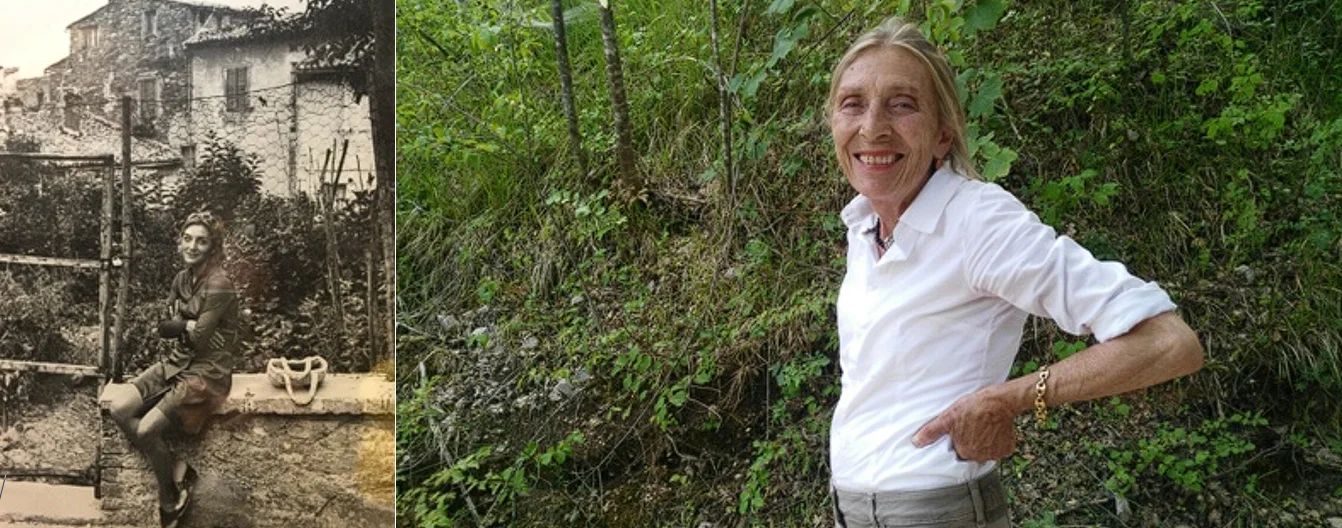
Now, the torch passes to the fourth generation: following the founder Angelo Olivieri, his son Filemone, and Ms. Rosa, it is now the turn of her daughter Teresa—an actress and theater trainer—who, alongside her husband Alessandro—a journalist and documentary filmmaker—is working on a second rebirth for Colle. The goal is to keep intact the industrious spirit that has always defined this location, reopening its doors to hospitality for those seeking the authentic values of our inland regions.
With a commitment to preserving its rustic yet elegant character, while focusing fully on cultural and artistic research and the rediscovery of the location's natural resources, the new owners' vision is to rebuild a sense of community around this rural complex. This inspired the idea to convert a large part of the warehouse once used for agricultural production into multi-purpose rooms designed for theatrical activities, as well as dance, Qigong, concerts, and cultural events in general.
The agricultural side centers on the cultivation of aromatic herbs, primarily dedicated to the extraction of essential oils. With these, we have already created our first line of natural body care products: hand wash, shampoo, body wash, and body lotion, which you will find in the agriturismo's bathrooms and can also purchase at the end of your stay in Colle. To complement our farming activities, the villa's garden hosts a small apiary of Italian honeybees (Italian Ligurian bees) for the family production of wildflower honey, drawing sustenance from the rich biodiversity surrounding the Springs of the Potenza.